 Canada
  United Kingdom
  United States

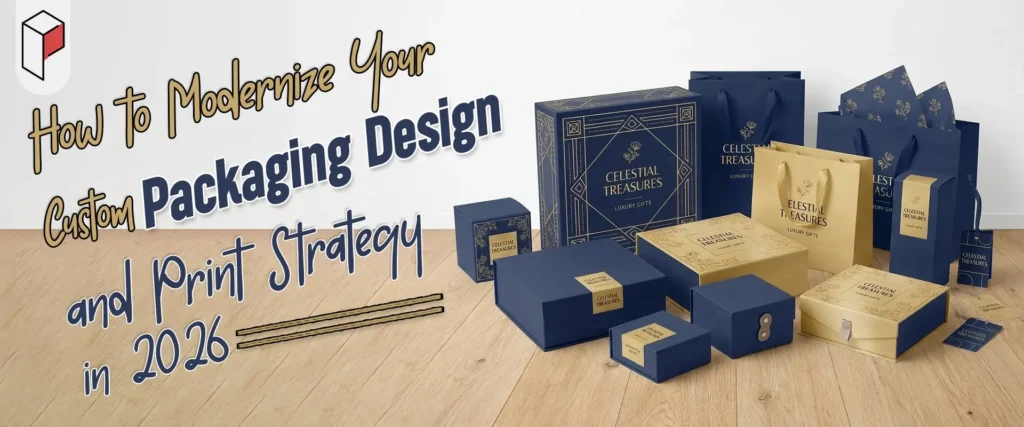
How to Modernize Your Custom Packaging Design and Print Strategy in 2026
You know that feeling when a package shows up, and you are actually kinda excited to open it? Doesn’t happen every time, honestly. Most days it’s just a box. You tear it open and grab the thing, and that’s it. But every once in a while there’s one that just hits different before you’ve even opened it properly. Could be the material, could be how it’s put together, not really sure what it is exactly. You just know it right away.
Now think about the opposite. The box shows up looking beat up, or wrapped in that cheap plastic that crinkles weirdly, and something about the packaging design already makes you feel a little less excited, even before you’ve seen what’s inside. Nobody says this out loud, but it happens to pretty much everyone.
So this one’s different. This isn’t that kind of article. It’s about what’s actually changing in custom packaging this year, things you can realistically use without a huge budget or a design team. Better materials, sturdier builds that survive a rough shipping process, small touches that make a product feel considered. Not gold foil. Just packaging that does its job and still makes someone pause for a second when they open it.
2026 Packaging Trends Worth Paying Attention To
There’s a lot of noise out there about ‘the future of packaging,’ most of it aimed at brands with budgets most of us don’t have. So instead of going through every single shift happening in the industry, here’s what’s actually showing up in real custom boxes orders this year, and what you can realistically use without flipping your whole setup upside down.
Sustainable Materials Become the Default
Not that long ago, if your packaging said ‘eco-friendly’ somewhere on it, that alone made people take notice. Now it’s just expected, and honestly kind of assumed. People order a candle or a box of cookies and they notice right away if the packaging design feels like stiff, cheap plastic instead of something considered. Kraft paper and plain corrugated board have quietly become the default for a lot of brands, not because it’s trendy but because customers stopped putting up with the alternative.
There’s a practical side too that doesn’t get talked about enough. Kraft and corrugated materials usually cost less than laminated or coated boxes. A bakery switching to simple kraft packaging isn’t losing anything visually either, if anything, it ends up looking more genuine than something overly polished. Retail brands are seeing the same thing, corrugated mailers are replacing boxes stuffed with plastic air pillows.
Minimal, Single-Material Packaging
A lot of custom packaging design still has way too much going on. Plastic window here, a printed sleeve wrapped around it, tape holding the whole thing together. Looks okay sitting on a shelf. But try recycling it and that’s where it falls apart, literally. None of those pieces come apart clean, so the whole box usually just ends up in the trash instead.
Single-material boxes fix this without much effort. One material means the box can go straight into recycling, and production stays simpler too. Fewer materials, fewer steps, lower cost. None of this means the packaging has to look plain or cheap. A single-material box doesn’t have to look basic either; get the print right and it still looks sharp. It just comes down to not overcomplicating something that was fine to begin with.
Food and Bakery Packaging Gets an Upgrade
Food packaging didn’t used to be this complicated. It just needed to hold the food and stop it from spilling everywhere. That’s not really enough anymore, especially for bakeries and small food brands trying to get noticed online. People take pictures of their orders now, so the box has to look decent too, not just survive the drive home.
Grease-resistant liners, sturdier corrugated builds, cleaner branded printing, all of that has kind of become the norm for anyone shipping baked goods or takeout. It’s one of the clearer packaging trends showing up in food boxes and bakery boxes this year. It’s not really about going overboard with design either. It’s more that customers expect the packaging to match the effort that went into the food itself. A nice cake sitting in a soggy, stained box just doesn’t hit the same.
For most of the businesses, this is an easy upgrade. You do not have to redesign the whole packaging. A mere upgrade of the material to a high-quality one will be sufficient.
Make Product Feel Premium Without a Luxury Budget
It does not matter what you are selling as a brand. From candle boxes to skincare, your boxes hold a lot of importance. People see the box first. Before the product, before anything else. And it’s got to feel worth what they paid, even if what they paid wasn’t much.
- Soft-touch or matte coating doesn’t change what the box is made of, just how it feels in your hand, and that alone makes something feel a step above basic.
- A little foil used for design detailing will give you a box that is attractive and high-end in appearance.
- Slightly thicker board, like what you’d find in rigid boxes, makes the packaging feel sturdier right away, and that alone reads as more expensive, even if nothing else changed.
- Simpler print design means less going on and usually looks more put together than something busy and crowded.
None of this needs a full redesign or some huge production run behind it. For smaller brands going up against bigger names, that first moment of picking it up matters more than people give it credit for.
Final Thoughts
You don’t need some big rebrand for this. Or a whole design team. Just better materials, smarter packaging design, and boxes that don’t fall apart halfway through delivery. Small stuff that makes things feel a little nicer than they had to. That’s basically it. And the brands actually doing well with this in 2026, they’re not throwing more money at it. They’re just paying attention to the small things. The stuff people see but don’t really talk about.
If you’re not sure where to start, Pack Prints works with businesses of pretty much any size on custom packaging, sustainable materials, better finishes, none of the crazy high minimum orders that make it hard for smaller brands to even try. Get a quote and see what actually works for your product.